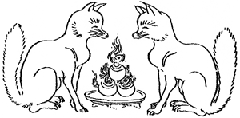
 Karen A. Smyers was born on Halloween in 1954. After majoring in Religion at Smith College, she spent her pre-graduate school years working in the U.S. Congress and the Dean's Office at Smith, then teaching English and studying Japanese in Japan. After receiving her Ph.D. in Anthropology from Princeton University, she taught in the Religion Department at Wesleyan University for 8 years offering such courses as “Death and the Afterlife in World Cultures,” “Magic, Science, and Religion,” and “Imagining the Other: Alterity Theory in Religious and Anthropological Perspective.” Her book, The Fox and the Jewel: Shared and Private Meanings in Japanese Inari Worship, was published by the University of Hawai'i Press in 1999, and she received tenure in May 2000. Karen A. Smyers was born on Halloween in 1954. After majoring in Religion at Smith College, she spent her pre-graduate school years working in the U.S. Congress and the Dean's Office at Smith, then teaching English and studying Japanese in Japan. After receiving her Ph.D. in Anthropology from Princeton University, she taught in the Religion Department at Wesleyan University for 8 years offering such courses as “Death and the Afterlife in World Cultures,” “Magic, Science, and Religion,” and “Imagining the Other: Alterity Theory in Religious and Anthropological Perspective.” Her book, The Fox and the Jewel: Shared and Private Meanings in Japanese Inari Worship, was published by the University of Hawai'i Press in 1999, and she received tenure in May 2000.
In the fall of 2001 Karen went to Zürich, Switzerland to study at the Jung Institute. During her time there, the Institute underwent a crisis and split into two. Karen studied at both schools, and her diploma is from ISAP, the International School for Analytical Psychology.  The program, which took six years to complete, requires 300 hours of personal analysis, two years of coursework followed by qualifying examinations, 300 hours of supervised analysis with clients, final exams, and a thesis. Her thesis continued her fascination with the “foxy” aspects of cultures, humans, and the psyche, and is called, “The Canny Feminine: The Conscious Union of Eros and Logos.” The program, which took six years to complete, requires 300 hours of personal analysis, two years of coursework followed by qualifying examinations, 300 hours of supervised analysis with clients, final exams, and a thesis. Her thesis continued her fascination with the “foxy” aspects of cultures, humans, and the psyche, and is called, “The Canny Feminine: The Conscious Union of Eros and Logos.”
Karen has moved her private practice from Zürich to Easthampton, Massachusetts.
Selected Publications:
-- Transfigured Being: A Gender-Fluid Model of Jungian Individuation from Ancient Egyptian Mythology. [In process]
-- The Intellectual Journey of Manisha Roy: In Double Perspective. Living in Many Worlds: A Festschrift Celebrating Manisha Roy. Sumit Nag, et.al.,eds. Kokata, India: Yapanchitra, 2011, pp. 107-19.
--The Canny Feminine: The Conscious Union of Eros and Logos. Diploma Thesis, International School of Analytical Psychology, Zurich, 2007.
Part 1 Part 2 Part 3 Part 4
-- Shaman/Scientist: Jungian Insights for the Anthropological Study of Religion. Ethos: Journal of the
Society for Psychological Anthropology 29(4), Winter 2001.
--The Fox and the Jewel: Shared and Private Meanings in Contemporary Japanese Inari Worship,
University of Hawaii Press, 1999.
-- Inari Pilgrimage: Following One’s Path on the Mountain, Japanese Journal of Religious Studies 24(3-4):
427-452, 1997.
-- “My Own Inari”: Personalization of the Deity in Inari Worship, Japanese Journal of Religious Studies
23(1-2):85-116, 1996.
-- The Japanese Altar, in The Dictionary of Art, London: Macmillan, 1996
-- Of Foxes, Buddhas, and Shinto Kami: The Syncretic Nature of Inari Beliefs, Japanese Religions, Vol.
16, #3, January 1991, pp. 60-75.
-- Women in Shinto: The Relation Between Purity and Pollution, Japanese Religions, Vol. 12, #4, July
1983, pp. 7-19. |
|